How many of the agents your teams build this year will be rebuilt by another team that couldn't find them?
Is there real value in open standards for AI? And if you have watched this film before, in web services or APIs, how did it end for you?
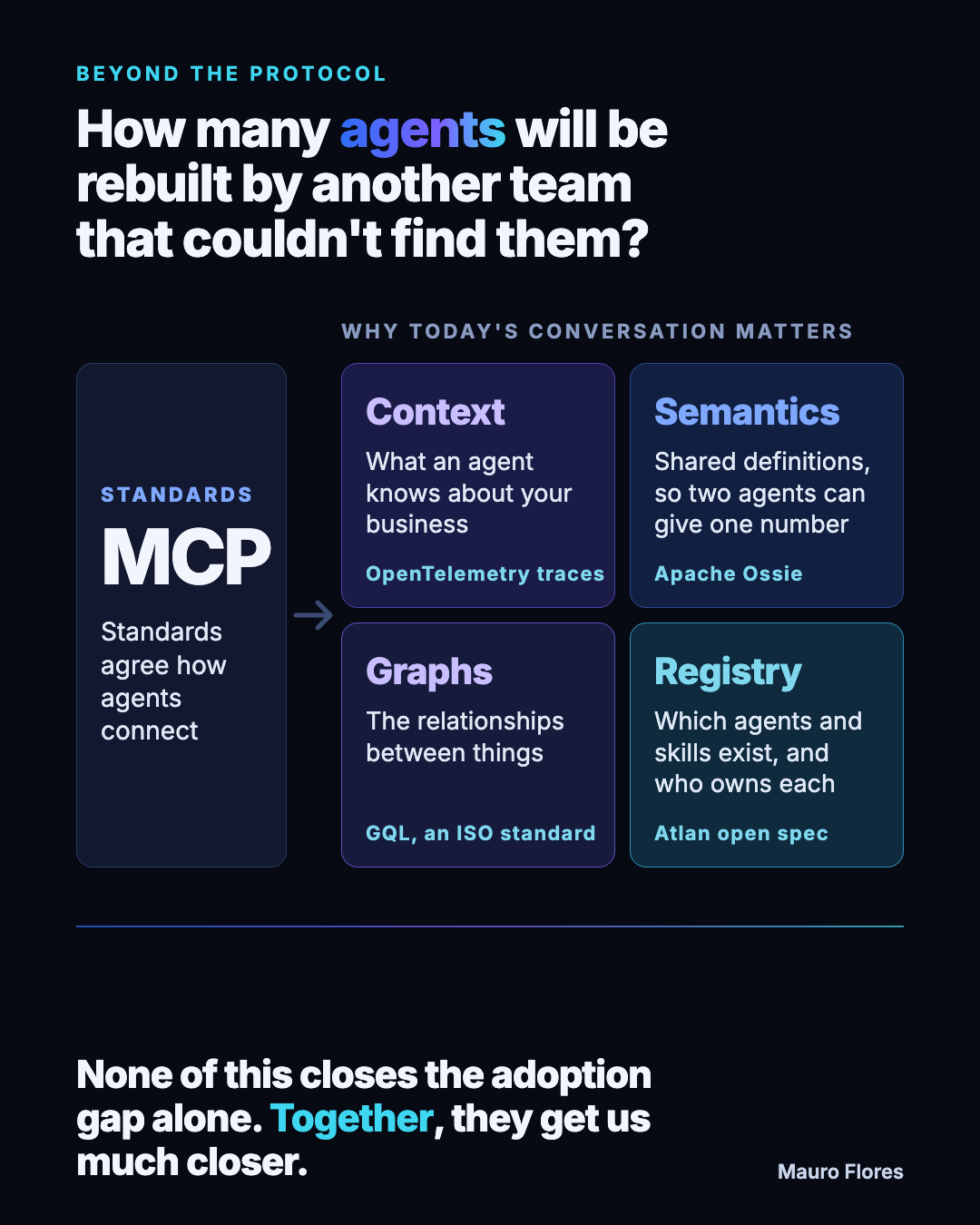
Standards are one piece of what agents need inside a company. This piece looks at four more. Context is what an agent knows about your business. Semantics is what a term like revenue means across the business. Graphs hold the relationships between things. A registry is where agents, skills and tools are listed, versioned and found. Each section starts with agents and skills, and brings in the web-services parallel second.
Rival AI companies are backing a shared home for agent standards
It is good to see. In December 2025 Anthropic gave MCP to the Linux Foundation's new Agentic AI Foundation, co-founded with Block and OpenAI, with AWS, Google and Microsoft among its members. The Linux Foundation's Jim Zemlin said the foundation lets its agent projects coordinate "interoperability, safety patterns, and best practices". Detail and links are in the section on the people doing the work, further down.
Agents now share a way to connect. Standards need to be agreed, but it shouldn't stop here. Web services went through the same lifecycle: SOAP defined the protocol, a WSDL file described what each service accepted, and the struggle was discoverability, reuse and consistency. That's why today's conversation about context, semantics, graphs and registries matters.
Context: what an agent knows about your business
For a business user, context is what an agent knows about your business: what each tool or dataset is for, who owns it and which version to trust. Technically, it's everything the model sees at each step, from instructions and tool descriptions to retrieved data and memory. Testing reads that trace step by step; OpenTelemetry is standardising it. Today an agent or skill's description says how to call it, and little about who owns it or which version is approved. That is the gap context has to fill: who owns it, whether it is current, and which files belong together.
Web services had the same gap. In my experience a WSDL, the file that described what a web service accepted, told you its shape. It didn't say who owned it or whether it was current.
Semantics: two agents, two numbers for revenue
Ask two agents for revenue and you can get two answers. Each is doing its job; the definition lives in a different place for each. Fixing that takes two things: somewhere to find the agents and skills, and a shared meaning for the words they use.
The same goes for a term like "active customers". Ask two agents and you can get two numbers. They read different definitions and different context, and the models aren't deterministic, so even the same question can come back differently.
A semantic layer gives agents shared definitions. A knowledge graph gives them the relationships between things. I see them as complementary.
APIs lived this too. REST fixed the interface, RAML and Swagger competed until the industry converged on OpenAPI, and yet meaning still had to be agreed. The Open Semantic Interchange, started by Snowflake with Salesforce and dbt Labs, now sits in the Apache Incubator as Apache Ossie, and no single vendor owns it. Its first spec came out in January. More on it below.
Neither is a new idea, and the last two decades taught the same lesson: a standard only matters if it makes reuse the easy path.
Graphs: the relationships between things
Graphs have been around for years, and they matter more for agents. Neo4j led for years; now GQL (ISO/IEC 39075, published in 2024) is an ISO standard, which Google and Microsoft support: Google in Spanner Graph, Microsoft in Fabric.
The registry: what SOAP taught me
For agents, a registry is a shared list of which agents and skills exist, who owns each one and which version is approved. Google, AWS and Microsoft now offer one in their platforms, and Atlan has released an open spec for one. The web-services parallel is the registry I used in my Oracle middleware years.
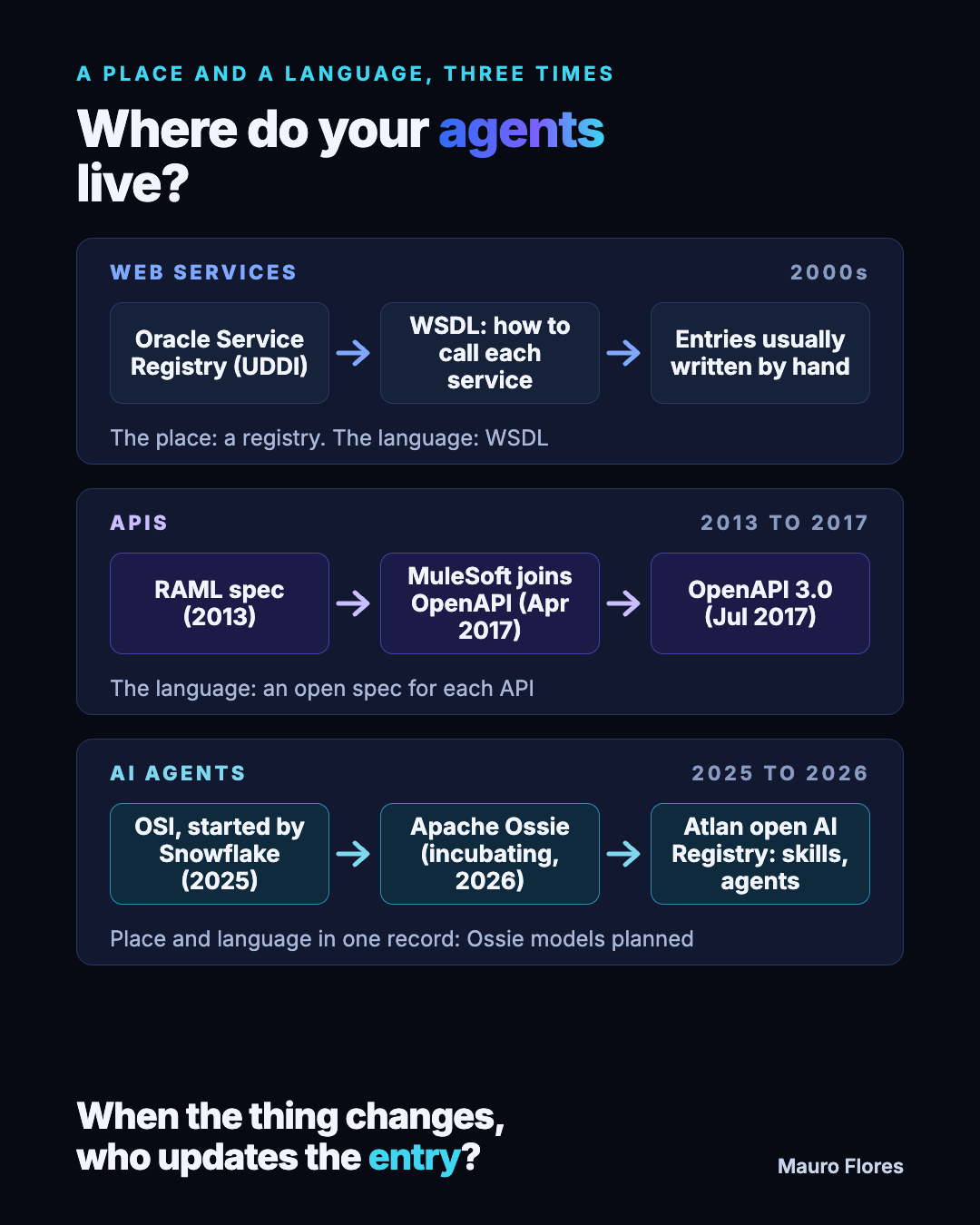
In my Oracle middleware years we ran our web services through Oracle Service Registry. UDDI said where a service lived, and a WSDL file said how to call it.
My view, and it's only my view, is that the protocol was not the big problem. Reuse was. Discoverability was. Engineers recreated services that already existed, worked against old versions, fought compatibility, and at scale the whole thing became hard to manage. UDDI entries were usually written by hand at design time while services kept changing at runtime, and the Apache jUDDI docs say plainly that such data can grow stale.
REST fixed the interface. It didn't fix the problem. You still had to find the API and know which version to trust. That is why RAML and Swagger appeared, and why the industry converged on OpenAPI, which now guides the practice. I was at MuleSoft when it joined the OpenAPI Initiative under the Linux Foundation in April 2017. Swagger's own post that month was headed "The End of the API Spec Wars"; Swagger had a stake in the outcome, so read that as a signal rather than a verdict.
The common thread in each era was a common place to look and a common language to speak. Registries gave the place. Specs gave the language.
Can an open standard still fail?
A fair warning first. Tony Tam, who created Swagger, said this in 2015:
"From my point of view, the CORBA problem is simply 'Design by Committee'. You simply cannot have a successful specification if you try to solve everybody's problems with it."
Tony Tam, creator of Swagger, InfoQ, 9 June 2015
Open standards fail when they try to be everything. The ones that last stay small and describe what people already do. That is my test for everything below.
The people doing the work
Many companies are putting real effort into something none of them owns, and they deserve naming.
Anthropic opened the Model Context Protocol in November 2024 and called it "a universal, open standard for connecting AI systems with data sources". That is from its launch post. MCP now sits with the Agentic AI Foundation, which Anthropic co-founded with Block and OpenAI. AWS, Google and Microsoft are among its members, per the Linux Foundation's announcement. The Linux Foundation's Jim Zemlin said the move lets the community "coordinate interoperability, safety patterns, and best practices specifically for AI agents". TechCrunch reported it on 9 December 2025.
On meaning, Snowflake started the Open Semantic Interchange in September 2025 with Salesforce and dbt Labs. The core developers come from Snowflake, Dremio and dbt Labs. Since July it has been Apache Ossie in the Apache Incubator, so a foundation holds it and no vendor does. It describes metrics, dimensions and relationships in one open format. Atlan joined as a launch partner, and the Incubator proposal lists it among the companies whose contributors have landed commits.
Who else is building a registry
There is plenty of good work here, and each piece solves a real problem for its own customers. As each vendor describes it:
| Registry | What it covers |
|---|---|
| MCP Registry | Publicly accessible MCP servers; the official registry, in preview |
| A2A agent cards | An open spec for an agent to describe its identity and skills |
| AWS Agent Registry (Bedrock AgentCore) | MCP servers, tools, agents, skills and custom resources, with an approval workflow |
| Google Cloud Agent Registry | Agents, tools and MCP servers inside Google Cloud |
| Microsoft Entra Agent ID | Who each agent is, who owns it and what it may do |
| Kong AI Registry | Models, MCP servers, tools, agents and skills, with ownership and approval |
| Salesforce Agentforce | AI agents across the enterprise, managed alongside the workflows they support |
| Databricks Unity Catalog Semantics | Governed metrics and business definitions, open source and OSI-compliant |
| Collibra | AI use cases, models and agents, so they can be governed |
Most of these are managed services that work with open protocols such as MCP and A2A. That is a sensible way to build it.
Today Google, AWS and Microsoft run agent registries in their platforms. AWS announced general availability of its Agent Registry on 31 August 2026, Google's Agent Registry went generally available on 18 June 2026, and Microsoft's Agent 365 gives organisations a single, centralised registry of their agents.
Why Atlan's release caught my eye
At its Context Conference on 28 October, which I joined online, Atlan released an open AI Registry spec for skills and agents. What is different is the shape. It is a file-based spec under Apache 2.0. Entries carry versions, digests and a lifecycle status, held on storage you already control, with an aireg command line tool. No single platform has to hold the list.
Two honest caveats. The spec is a draft, v0.1, and the tool has not reached 1.0. And semantic models in the Apache Ossie format are planned. Atlan's engineering blog of 30 October says so; they aren't in the public repository today. They're the part I'm watching most closely. If it lands, the list of agents and what revenue means would sit in one record, side by side.
I run my own registry on Atlan's spec, to see where it holds.
Prukalpa, Atlan's co-founder, wrote about the gap on 5 November in an article titled "Context Needs Its Iceberg Moment". Today's formats, she says, "don't tell those tools which files belong together or which version is current". It's the WSDL gap again. Prukalpa's article is linked in the sources.
How I use all four
The geek in me uses all four, at work and home. My agents start every task knowing my background, and each term has one meaning. A graph connects the dots across 25 years. My own registry keeps 50+ skills and 60+ agents easy to find. That's when experience compounds: my agents get faster and more accurate.
Something to keep an eye on
Agents decide what to call, so context and trust matter more than ever.
The adoption gap
Structure alone won't close the adoption gap. Gartner's 2025 headline: "Over 40% of Agentic AI Projects Will Be Canceled by End of 2027". Someone has to own each agent, teams have to trust it enough to stop rebuilding it, and ways of working have to change. All three are my view, not Gartner's.
Together, context, semantics, graphs and registries get us much closer. And if we agree the standards, we avoid locking ourselves into one platform or tool.
What I would ask of any registry
The entry is only part of what decides whether two agents agree on revenue. The rest is design time against runtime: what someone wrote down once, against what is running today. So I'd ask four things of any registry. Can I find what exists? Do I know what it means? Can I trust the version? Can I see who changed it?
I advise CEOs and executive committees now, and my message to them is the one I would give an architect. The next five years will be decided by who can trust AI enough to let it do real work, with people still accountable. A registry is where that accountability gets written down.
How are your teams managing context, meaning and versions across agents and skills? I'd like to learn what's working.
And for architects and data leaders: should agents and business definitions live in one registry or two, and who is allowed to change them?
Sources and further reading
- Tony Tam, InfoQ interview, 9 June 2015: https://www.infoq.com/articles/swagger-interview-tony-tam/
- Anthropic, Model Context Protocol, 25 November 2024: https://www.anthropic.com/news/model-context-protocol
- TechCrunch on the Agentic AI Foundation, 9 December 2025: https://techcrunch.com/2025/12/09/openai-anthropic-and-block-join-new-linux-foundation-effort-to-standardize-the-ai-agent-era/
- Swagger, "MuleSoft Joins the OpenAPI Initiative: The End of the API Spec Wars", 25 April 2017: https://swagger.io/blog/news/mulesoft-joins-the-open-api-initiative/
- MuleSoft press release, April 2017: https://prwire.com.au/pr/69821
- RAML specification repository (raml-org/raml-spec, opened 30 September 2013): https://github.com/raml-org/raml-spec
- OpenAPI Initiative, "The OAI Announces the OpenAPI Specification 3.0.0", 26 July 2017: https://www.openapis.org/blog/2017/07/26/the-oai-announces-the-openapi-specification-3-0-0
- MCP Registry: https://modelcontextprotocol.io/registry/about
- Oracle Service Registry: https://www.oracle.com/technetwork/middleware/registry/index.html
- OASIS, Using WSDL in a UDDI Registry: https://www.oasis-open.org/committees/uddi-spec/doc/tn/uddi-spec-tc-tn-wsdl-v2.htm
- Apache jUDDI documentation: https://github.com/apache/juddi
- Apache Ossie enters the Incubator: https://ossie.apache.org/updates/ossie-enters-apache-incubator/
- Apache Ossie incubation proposal: https://cwiki.apache.org/confluence/spaces/INCUBATOR/pages/430408796/OssieProposal
- OpenTelemetry, semantic conventions for GenAI agent spans (status: Development): https://github.com/open-telemetry/semantic-conventions-genai/blob/main/docs/gen-ai/gen-ai-agent-spans.md
- Snowflake, OSI specification now live, 27 January 2026: https://www.snowflake.com/en/blog/open-semantic-interchanges-specs-finalized/
- Apache Ossie on GitHub: https://github.com/apache/ossie
- ISO/IEC 39075:2024, GQL: https://www.iso.org/standard/76120.html
- Google Cloud, Spanner Graph overview (ISO GQL-compatible query interface): https://docs.cloud.google.com/spanner/docs/graph/overview
- Microsoft Learn, GQL Language Guide for graph in Microsoft Fabric: https://learn.microsoft.com/en-us/fabric/graph/gql-language-guide
- Snowflake on Apache Ossie, 8 July 2026: https://www.snowflake.com/en/blog/apache-ossie-open-semantic-interchange-incubator
- Atlan, launch partner for OSI: https://www.atlan.com/snowflake-open-semantic-interchange-launch-partner/
- Atlan AI Registry spec (Apache 2.0, draft v0.1): https://github.com/atlanai/ai-registry
- Atlan engineering, Introducing AI Registry, 30 October 2026: https://blog.atlan.com/engineering/introducing-ai-registry/
- Google Cloud Agent Registry: https://docs.cloud.google.com/agent-registry/register-mcp-servers
- Linux Foundation, Agentic AI Foundation formed, 9 December 2025: https://www.linuxfoundation.org/press/linux-foundation-announces-the-formation-of-the-agentic-ai-foundation
- A2A agent discovery: https://github.com/a2aproject/A2A
- AWS Agent Registry (Bedrock AgentCore): https://docs.aws.amazon.com/bedrock-agentcore/latest/devguide/registry.html
- Microsoft Entra Agent ID: https://learn.microsoft.com/en-us/azure/foundry/agents/concepts/agent-identity
- Kong AI Registry: https://konghq.com/products/ai-registry
- Salesforce, What is an AI agent catalogue?: https://www.salesforce.com/uk/agentforce/ai-agents/ai-agent-catalog/
- Databricks, Unity Catalog Semantics: https://www.databricks.com/product/unity-catalog/business-semantics
- Prukalpa, "Context Needs Its Iceberg Moment", LinkedIn, 5 November 2026: https://www.linkedin.com/pulse/context-needs-its-iceberg-moment-prukalpa--j8mjf/
- Gartner, "Gartner Predicts Over 40% of Agentic AI Projects Will Be Canceled by End of 2027", 25 June 2025: https://www.gartner.com/en/newsroom/press-releases/2025-06-25-gartner-predicts-over-40-percent-of-agentic-ai-projects-will-be-canceled-by-end-of-2027
- AWS, Agent Registry generally available, 31 August 2026: https://aws.amazon.com/about-aws/whats-new/2026/08/aws-agent-registry-generally-available
- Google Cloud, Gemini Enterprise Agent Platform release notes (Agent Registry GA, 18 June 2026): https://docs.cloud.google.com/gemini-enterprise-agent-platform/release-notes
- Microsoft Learn, Agent 365 and Entra Agent ID registry: https://learn.microsoft.com/en-us/entra/agent-id/agent-registry-convergence
- Collibra AI model and agent inventory: https://www.collibra.com/blog/ai-model-and-agent-inventory-how-to-catalog-every-ai-system-in-your-enterprise